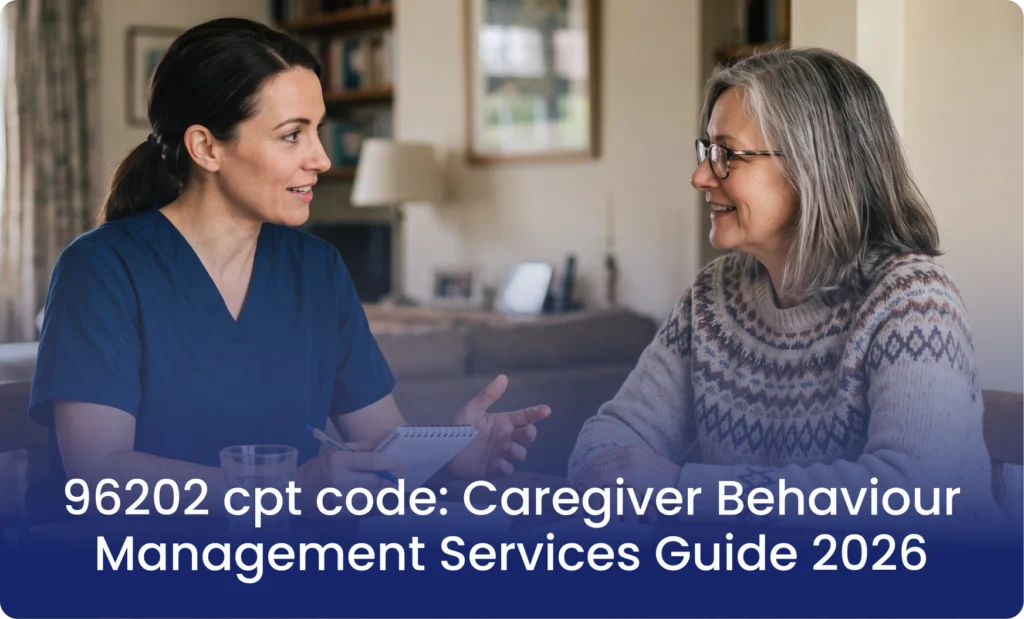
96202 cpt code indicates the 60 minutes of a face-to-face session with an entire family regarding behaviour modification techniques and management.The actual service is CBMT (Caregiver behaviour training services, where a provider educates the patient`s guardian to manage and monitor his/her behavioural health.
This comprehensive CBMT guide will cover everything about 96202 caregiver training such as 96202 reimbursement and 96202 vs 96203.
What is 96202 Caregiver Training
Two new codes 96202 and 96203 were introduced in 2023 indicating behavioural management services. Where a physician or a professional healthcare physician provided a session about behavioural modification to the caregivers in the absence of the patient.
Assigning these codes indicates the efforts of physicians behind training the guardians of the patients. The training includes methods for handling the patient’s diseases in the best possible way.
Healthcare experts receive reimbursement against these codes for the patient visits, the treatment and moderate-level medical decision making.
Importance of Group Caregiver Training Billing Services
CPT 96202 represents the initial 60 minutes of multiple-family group behavior management or modification training, while CPT 96203 is reported for each additional 15 minutes.
A Key reason behind group caregiver training billing services is the involvement of the patient family who has been diagnosed with physical/mental health related issues. During the session, expert healthcare provides training for the family about particular behavioural adjustment patterns. The aim is to help patients live a normal life by responding positively to the circumstances.
The group caregiver training billing services help patient fight with
- Asthma,
- Anxiety
- ADHD
- Autism spectrum disorders
- Cystic fibrosis, depression
- Diabetes
- Eating disorders
- elimination disorders
- gastrointestinal disorders
Some other disorders include dementias, Parkinson’s, Huntington’s), obsessive-compulsive disorder, obesity,substance use disorders and sleep disorders
Important Aspects of 96202 Caregiver Training
There is a comprehensive description in CPT 2023 manual about the CBMT services, indicating the situation in which the services are given. These involve
- In-person visit in the presence of a caregiver
- Multifamily setting
- In the absence of Patient
Furthermore, offering 96202 caregiver training requires experience and expertise of a physician or a qualifying non-physician. The expert must have a strong command on the behavioural management and procedures of modification.
CPT 96202 Reimbursement
CPT 96202 reimbursement is not a single nationwide amount for every provider.
Medicare payment under the Physician Fee Schedule can vary based on factors such as geographic location, facility or non-facility setting, and applicable payment rules.
Therefore, providers should verify the current Medicare Physician Fee Schedule amount for their locality rather than relying on an old national figure.
Medicare Part B covers qualifying caregiver training services when the applicable requirements are met. Medicare beneficiaries generally pay 20% of the Medicare-approved amount after the Part B deductible, subject to applicable coverage and cost-sharing rules.
For commercial insurance, reimbursement can differ significantly by payer. Providers should check the patient’s plan, payer policy, contracted rate, and applicable coding requirements before submitting a claim.
Documentation Requirements
Accurate documentation is essential when billing CPT 96202. The medical record should show why caregiver training was necessary, what the provider taught, and how the session supported the patient’s treatment goals.
Patient and Caregiver Details
Document the patient’s diagnosis or qualifying health condition and explain why caregiver training was needed. Identify the caregiver group that participated and describe their role in supporting the patient.
Training and Behavioral Strategies
Record the specific training provided during the session. Avoid vague statements such as “caregiver education provided.” Instead, describe the behavioral strategies taught, such as reinforcing appropriate behavior or responding to challenging behavior.
The note should also include the training objectives and explain how the strategies relate to the patient’s treatment plan.
Provider and Time Details
Document the provider who furnished the service, date of service, and total training time. When applicable, include the start and end times.
If additional time is billed, the record should clearly support the extra training time reported. Documentation should always support the exact service billed.
Consent and Patient Presence
Document the required patient or representative consent before providing caregiver training. The record should also identify who participated in the session and whether the patient was present.
This is particularly important because caregiver training codes have specific requirements regarding patient participation and presence.
Progress and Treatment Goals
Explain how the training supports the patient’s treatment goals. Document the caregiver’s participation, questions, understanding of the strategies, and any recommendations for continued use.
This helps demonstrate that the service provided was specific, purposeful, and connected to the patient’s ongoing care rather than general caregiver education.
Telehealth Considerations
Caregiver training services can also be provided through telehealth when applicable requirements are satisfied. CMS added 96202 and 96203 to the Medicare Telehealth Services List beginning in 2025.
- Providers should still verify
- Current telehealth requirements,
- Eligible practitioners,
- Place-of-service rules, modifiers
- Payer-specific policies before billing.
Telehealth availability does not remove the need for proper documentation or patient consent.
Common Billing Mistakes
Several mistakes can create claim problems resulting in revenue loss.
Billing Group Codes for Individual Training
96202 and 96203 are group behavior management codes. They should not be used simply because a caregiver has undergone behavior training.
Confusing Behavior and Functional Training
Behavior management training and functional caregiver training have different coding options.
For example, 97550 and 97551 address caregiver training related to functional performance, while 96202 and 96203 address multiple-family group behavior management or modification training.
Missing Consent
Medicare requires consent from the patient or applicable representative for caregiver training. That consent should be documented.
Poor Time Documentation
Providers should maintain documentation that supports the reported service and additional time.
Using Old Payment Figures
Reimbursement amounts can change with annual Medicare Physician Fee Schedule updates. A rate found in an older article may no longer be accurate.
Example
Imagine a behavioral health provider conducts a group session for caregivers from several different families.
The provider spends the first 60 minutes teaching behavior management strategies related to the patients’ treatment goals.
The session then continues for another 15 minutes.
The initial service is reported with 96202. The additional qualifying 15 minutes may be reported with 96203 when payer requirements are satisfied.
If the provider instead trains caregivers supporting only one beneficiary, the provider should review the individual-beneficiary behavior management codes rather than automatically using the group codes. CMS specifically distinguishes these services.
Final Takeaway
CPT 96202 is designed for multiple-family group behavior management or modification training for caregivers. It covers the initial 60 minutes, while 96203 is used for qualifying additional 15-minute periods.
The biggest billing point is simple: these codes are group-only behavior management services. Providers should confirm the patient’s eligibility, obtain and document consent, support medical necessity, document the training, and verify current payer rules before submitting claims.
For healthcare organizations handling caregiver training claims, MediRemote can help support accurate medical billing workflows, documentation processes, and reimbursement management while providers focus on patient care.
FAQs
What does CPT 96202 cover?
CPT 96202 covers the initial 60 minutes of multiple-family group behavior management or modification training provided to caregivers without the patient present.
Is CPT 96202 a group code?
Yes. CPT 96202 is specifically designed for multiple-family group behavior management or modification training involving multiple sets of caregivers.
What is CPT 96203 used for?
CPT 96203 reports each additional 15 minutes of qualifying multiple-family group behavior management or modification caregiver training beyond the initial service.
Can the patient attend 96202 training?
No. The code describes caregiver training provided without the patient present. Providers should document the caregiver-only nature of the service.
Does Medicare cover caregiver training?
Yes. Medicare Part B covers qualifying caregiver training when coverage requirements are met and the service supports the patient’s treatment or care goals.
Does 96202 have one fixed reimbursement rate?
No. Medicare reimbursement can vary by locality, setting, and payment rules. Providers should verify the current Physician Fee Schedule for accurate rates.