
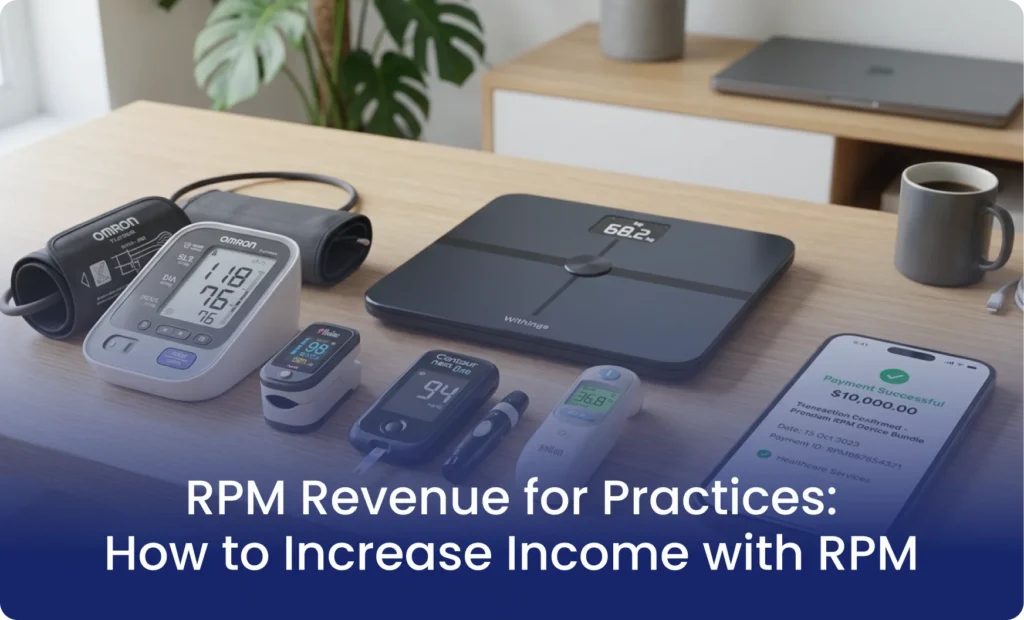
The widespread adoption of Remote Patient Monitoring is transforming the United States healthcare landscape. Harvard Health letter reports that nearly 50 million Americans use RPM devices. Another survey reveals that approximately 80% of the U.S. population favors incorporating RPM into their personal care.
These data suggest to us that remote patient monitoring is no longer just a nice add-on for medical practices. It has become a practical way to improve patient care while creating a steady new revenue stream.
The challenge is that many practices are not always sure how to turn it into real financial growth. This blog will break down how remote patient monitoring revenue works and what you can do to build a more profitable RPM program.
What is Remote Patient Monitoring?
Remote patient monitoring is one of those innovations that quietly transformed how practices deliver care. It involves using FDA-cleared devices to track key health metrics right from a patient’s home. The data gets securely transmitted to your team. This will help the team spot trends, catch issues early, and make timely adjustments.
RPM bridges the gap between office visits and everyday life. It helps clinicians stay connected to patients with chronic or ongoing conditions and makes care feel more continuous and personal. That combination of clinical value and practice growth is exactly why remote patient monitoring has become such an important part of modern healthcare.
RPM Revenue Per Patient
Understanding the concrete numbers is essential when looking at the financial sustainability of an RPM program. The total revenue generated per patient is not a static flat fee. But it scales dynamically based on the level of clinical engagement and the patient’s adherence to using their device each month.
A compliant Medicare Part B patient enrolled in an RPM program will generate between $73 and $140+ per month in recurring reimbursements. These number usually grows when the program is managed well and patients stay engaged.
Here are the key factors that influence RPM revenue per patient:
- Patient Enrollment
- Device Setup and Patient Education
- Monthly Device Monitoring
- Clinical Staff Time
- Accurate Documentation
- Patient Engagement
- Payer Mix
- Billing Compliance
- Program Efficiency
- Scalable Growth Opportunities
How Much Can a Practice Make From RPM
The discussion quickly shifts from high-level clinical concepts to operational math when healthcare executives and clinical partners assess RPM models. The real-world financial yield of a remote monitoring program depends on a number of factors. Those factors were discussed above.
Here is a grounded look at what real practices are earning in today’s environment.
Revenue Benchmarks by Practice Size
Smaller practices often start conservatively with 25-50 enrolled patients. Many see $3,000 to $9,000 in monthly gross revenue at this level. That is meaningful extra income without major disruption. It frequently grows into $10,000-$18,000 per month once they scale to 75–100 patients.
Medium and larger groups with 100-300 active RPM patients commonly report $12,000 to $45,000+ monthly.
| Annual Gross Revenue Projections By Panel Size | |
| 100 Active Patients | 124,800 |
| 300 Active Patients | 374,400 |
| 500 Active Patients | 624,000 |
Annual Projections That Matter
Thinking yearly often makes the opportunity clearer. A mature program with 100 consistent patients can generate $120,000 to $220,000+ annually in gross RPM revenue. These numbers depend on compliance rates and billing optimization. Practices that layer services effectively sometimes push well beyond $250,000.
Net Profit and ROI Considerations
Gross revenue tells only part of the story. After platform fees, device costs, and dedicated staff time, many practices achieve 45-70% net margins once the program matures. Break-even often happens within 2-4 months for well-organized setups. The real long-term win includes fewer hospitalizations, better quality scores and stronger patient loyalty.
RPM Reimbursement Revenue
The financial success of an RPM program starts with understanding reimbursement. RPM reimbursement revenue refers to the payments providers receive for delivering qualified remote monitoring services to eligible patients. It creates a recurring source of income when implemented correctly.
Below are the key elements that contribute to RPM reimbursement revenue:
- Eligible Patient Population
- Use of Qualified Monitoring Devices
- Accurate CPT Code Billing
- Comprehensive Documentation
- Consistent Patient Participation
- Clinical Monitoring and Follow-Up
- Medicare and Commercial Insurance Coverage
- Compliance With Regulatory Requirements
- Technology That Supports Efficient Billing
- Ongoing Program Optimization
Key RPM CPT Codes and Their Reimbursement Rates
Here are the key RPM CPT codes and their 2026 Medicare national average reimbursement rates:
| CPT Code | Billing Frequency | 2026 National Avg. Rate |
| 99453 | One-time per episode of care | ~$22 |
| 99454 | Every 30 days | $52.11 |
| 99445 | Every 30 days | $52.11 |
| 99470 | Calendar month | $26.05 |
| 99457 | Calendar month | $51.77 |
| 99458 | Calendar month | $41.42 |
| 99091 | Every 30 days | ~$58 |
Costs and Challenges That Affect RPM Profitability
Remote patient monitoring can be exciting and profitable. But these benefits are only when a practice understands the real costs involved and plans for the common obstacles that can reduce returns. The strongest programs are usually the ones that treat remote patient monitoring as an operational system.
Below are some of the most common factors that can influence RPM profitability:
- Technology and Platform Expenses
Most practices pay a monthly per-patient fee for the RPM software. The technology can range from $8–$25 depending on features and support level. This usually includes device management and data dashboards.
- Device-Related Costs
Cellular-connected monitors represent an upfront investment. Many programs ship devices directly to patients. The cost of devices typically runs $30-$80 per unit.
- Staff Time and Workflow Integration
This is often the biggest hidden challenge. Reviewing data, documenting time and following up with patients takes effort. Each patient usually takes 15–30 minutes per month. The practices that stay profitable have a defined workflow rather than scattered extra tasks.
- Patient Engagement and Compliance Hurdles
Not every patient will transmit data consistently. Lower adherence directly reduces billable revenue. Common barriers include forgetfulness or discomfort with the technology. Successful teams invest time in clear onboarding and simple troubleshooting support to keep participation high.
- Billing and Documentation Complexity
Capturing full reimbursement requires accurate time tracking and proper documentation. Many practices initially leave money on the table due to missed codes or incomplete notes. Regular audits and staff training help close these gaps.
Best Practices to Maximize RPM Revenue
The focus should be on building a program that is easy to manage and financially consistent. Practices usually see the best results when RPM is treated as a structured part of care delivery rather than a side service.
Choose the Right Patients
Not every patient is an ideal fit for RPM. Patients with chronic conditions often create the strongest long-term value. It is because they need ongoing follow-up and are more likely to stay engaged.
Keep Workflows Simple
A complicated process can quickly reduce RPM performance. The most successful practices use clear steps for the following:
- Enrollment
- Device setup
- Patient education
- Monitoring
- Billing
These steps help staff move efficiently without missing important details.
Train the Team Well
Staff training has a direct impact on revenue because even small mistakes in documentation or billing can lead to lost reimbursement. Everyone involved should understand how RPM works and what needs to be tracked. A trained team is also better at spotting opportunities to improve collections.
Keep Patients Engaged
RPM only works well when patients stay active in the program. Regular check-ins and simple communication can help a lot. Patients will use their devices consistently and remain involved in their care. Better engagement usually leads to better outcomes and steadier revenue.
Partner With the Right Support
Many practices benefit from outside support when they are building or expanding an RPM program. The right partner can help improve setup and reduce administrative burden. They also make billing more efficient and can manage your entire billing. That often allows physicians and staff to focus more on care while the program continues to generate revenue.
Final Thoughts!
Remote patient monitoring gives practices a practical way to improve patient care while creating a more reliable revenue stream. RPM can become a meaningful part of long-term practice growth when the program is built around the right patients and a reliable platform.
The real value of RPM goes beyond reimbursement. It helps physicians stay connected to patients between visits and supports earlier intervention. It also makes care feel more personal and continuous. That combination of better outcomes and financial stability is what makes RPM such a strong opportunity for modern practices.
MediRemote is a helpful partner to consider for practices that want to explore RPM more confidently. Learn more about us by scheduling a free consultation by filling out the contact form.
Frequently Asked Questions
Is RPM still profitable in 2026 with all the recent changes?
Yes. It remains one of the stronger revenue opportunities for practices. The 2026 updates actually made it easier to bill for patients with slightly lower data transmission days.
Why is documentation so important in RPM?
Good documentation supports claims and helps avoid denials. It also makes it easier to prove that billable services were delivered.
What additional revenue stream for physicians?
Additional revenue streams for physicians include:
- Monetizing chronic care management
- Telehealth services
- Preventive care programs
- Wellness visits
How long does it usually take to see a return on investment with RPM?
Passive revenue medical practices saw a breakeven after joining the RPM program within 2 to 4 months. It becomes profitable after that as enrollment grows and processes improve.
Can small independent practices really succeed with RPM?
Yes. They often do very well. Smaller practices can be more flexible and give personalized attention. This helps with patient engagement and program success.