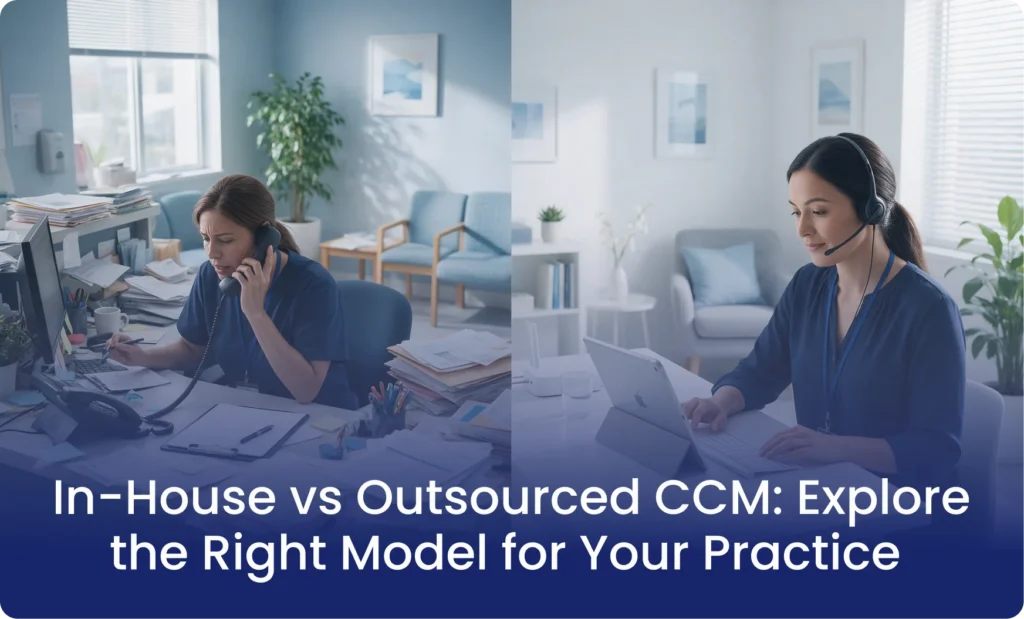
The majority of practices are already aware that managing chronic care can improve patients’ health in between visits and generate consistent Medicare revenue. But how to manage it without exhausting the team is the challenge.
Doing CCM in-house means your staff handles everything in-house. This gives you control over workflows and patient relationships. But it also means hiring, training and retaining the staff and dealing with software and compliance.
Outsourcing assigns routine tasks to a committed team while your doctors continue to make clinical decisions. Many practices find that they can maintain revenue growth and boost patient enrollment without adding new employees. Finding a partner who feels more like an extension of your clinic than a remote vendor is the best choice.
What Does In-House CCM Involve?
Running CCM in-house means your practice owns every part of the program. It’s a powerful model when you have the right team and systems in place. But it also comes with real operational demands. Below is a practical look at what building and managing an in-house CCM program actually involves.
Building the Right Team
Any in-house CCM program needs a dedicated care team. Most practices start with a care coordinator or nurse who can devote consistent time each month to CCM patients.
Depending on your patient panel, you may involve the following:
- A supervising physician or NP/PA
- Medical assistants or LPNs
- Front-desk staff
Creating and Maintaining Care Plans
CMS requires a comprehensive and individualized care plan for each CCM patient. Your team creates these plans in your EHR or care management platform and updates them regularly.
A strong care plan typically includes:
- Active problem list and medication reconciliation
- Measurable health goals set with the patient
- Symptom and medication management strategies
- Planned interventions and who is responsible for each
- Coordination notes for specialists and community resources
Tracking Time and Meeting CMS Requirements
To bill CPT 99490, your practice must record at least 20 minutes of non-face-to-face clinical staff time per patient, per calendar month. Calls, secure messages, coordinating care with specialists, and managing medications can all be part of that time.
In-house teams usually handle this by:
- Using timers or built-in tracking in their CCM/EHR software
- Logging date, duration, and staff member
- A brief note on what was addressed
- Ensuring the supervising provider reviews and signs off as required
Technology and EHR Integration
Your tech system is the backbone of an in-house CCM program. Most practices rely on a combination of:
- EHR-integrated CCM modules or standalone care management platforms
- Patient engagement tools
- Reporting dashboards to monitor enrollment, adherence, and revenue
Handling Billing, Compliance, and Audits
In-house CCM gives you full control over billing. But it also means you own the compliance risk. Your team must:
- Verify patient eligibility
- Obtain and store signed CCM consent forms
- Ensure monthly time thresholds are met and documented before claims are submitted
- Keep records audit-ready for at least several years
Weighing the Real Costs
Costs associated with managing CCM internally go beyond salaries. You are also investing in:
- Software licenses and EHR integration
- Training and onboarding for new staff
- Ongoing compliance monitoring and potential audit support
- Turnover coverage and backup staffing
What Does Outsourced CCM Involve?
Outsourced Chronic Care Management allows a practice to work with an external team that handles much of the program’s day-to-day workload. Your staff can stay focused on clinical care while the outsourced team supports patient engagement, care coordination, documentation, and other CCM tasks.
Partnering With an External CCM Team
An outside CCM team can take responsibility for routine program activities while working alongside your practice.
- Dedicated CCM care team
- Trained patient outreach staff
- Support with daily CCM tasks
- Defined roles and responsibilities
- Experience with CCM workflows
Managing Patient Outreach and Follow-Up
Consistent patient contact is easier when dedicated staff is responsible for regular CCM outreach and follow-up.
- Regular patient check-ins
- Care plan follow-ups
- Medication-related reminders
- Appointment follow-ups
- Escalation of patient concerns
Supporting CCM Documentation
The outsourced team can help keep CCM activities organized and properly documented throughout the month.
- Documented patient interactions
- Updated care plan information
- Organized CCM records
- Accurate time tracking
- Compliance-focused documentation
Handling CCM Billing Support
Some outsourced CCM providers also support billing processes, helping practices keep track of services and claims.
- CCM billing assistance
- Claim preparation support
- Service tracking
- Claim status monitoring
- Billing workflow support
Integrating CCM With Your Practice
A good outsourced program should fit into your existing practice workflow rather than operate separately from your care team.
- EHR workflow integration
- Easy team communication
- Shared patient information
- Regular performance reporting
- Streamlined care coordination
Reducing the Internal Staffing Burden
Outsourcing can help practices manage CCM without adding another major responsibility to an already busy internal team.
- Less workload for staff
- Reduced hiring requirements
- No separate CCM department
- Easier program scalability
- More time for patient care
Keeping Clinical Oversight With Your Practice
Outsourcing operational work should not mean giving up control of patient care. Your practice can maintain oversight of clinical decisions and patient care.
- Physician-led clinical decisions
- Clear escalation procedures
- Ongoing practice oversight
- Regular vendor communication
- Continued patient-care control
In-House vs Outsourced CCM: Key Differences
Choosing between in-house vs outsourced CCM often comes down to how much responsibility your practice wants to keep internally. Both models can support chronic care management. But they differ in staffing, daily operations, costs and oversight.
Your practice has direct control over the CCM workflow with an internal program. A large portion of the operational workload is transferred to an outside team with experience through outsourcing.
These two delivery models are contrasted in the following straightforward table:
| Factor | In-House CCM | Outsourced CCM |
| Control over workflows | Full clinical and operational control | Shared: practice retains clinical oversight |
| Staffing needs | Requires dedicated internal staff and ongoing training | Vendor provides trained care coordinators |
| Technology responsibility | You manage EHR/CCM tools, updates, and user access | Vendor often provides platforms |
| Upfront and ongoing costs | Higher fixed costs | More variable costs (percentage of collections, per-member fees) |
| Scalability | Limited by internal staff capacity and turnover | Easier to scale up or down as patient enrollment changes |
| Compliance workload | Your team handles all documentation and audit prep | Vendor supports standardized documentation |
| Best fit | Larger practices with existing care teams and resources | Smaller or growing practices |
Hybrid CCM Models: Combining In-House and Outsourced Care
Not every practice has to choose between all in-house or fully outsourced for Chronic Care Management. Hybrid CCM models, which combine internal staff with outside assistance, are being adopted by an increasing number of clinics. This strategy offloads the time-consuming tasks that frequently lead to burnout while allowing you to maintain control where it matters most.
Why Practices Choose a Hybrid Approach
A hybrid CCM model is usually driven by two realities:
- Your clinical team knows your patients best and should stay closely involved in care planning and complex decisions.
- Your office is already stretched thin with visits, prior authorizations, refills, and same-day issues.
You can maintain clinical quality without overburdening your employees or postponing patient follow-up by dividing up the work.
Tasks that often stay in-house:
- Comprehensive care plan creation and annual reviews
- Clinical decision-making and complex care coordination
- Final review of documentation before claims are submitted
- Managing high-risk or medically complex patients
Tasks that are frequently outsourced:
- Routine monthly patient calls and structured check-ins
- Basic symptom and medication adherence tracking
- Time logging and initial documentation of non-face-to-face work
- Patient education on program expectations and self-management tips
Conclusion
Choosing how to run Chronic Care Management rarely comes down to a single perfect answer. Some practices thrive when they keep everything in-house and stay close to their patients. Others find real relief by partnering with a vendor who can handle the monthly outreach and documentation at scale. And a growing number discover that a thoughtful hybrid approach gives them the best of both.
Look beyond the initial cost before deciding. Consider your patient volume, staffing capacity, current workflows, technology and compliance processes.
MediRemote can help you design a suitable program if you’re considering outsourced or hybrid CCM. Our team works alongside practices to design CCM programs that match your workflow and goals.
FAQs
What is the biggest downside of pure in-house CCM?
Staffing and consistency. Turnover or a sudden influx of sick patients can leave months of outreach incomplete. Billing then becomes inconsistent and patients notice the gaps.
Does outsourcing mean we lose clinical control?
No. You still own the care plan and clinical decision-making. The vendor works under your direction and escalates anything that needs a clinician’s attention.
Is a hybrid model realistic for a small practice?
Yes, a hybrid model can be realistic for a small practice. But it needs to be designed around your actual capacity instead of trying to do everything in-house.
Are there compliance risks specific to outsourcing?
There is no compliance risk with trusted partners like MediRemote. Choose partners who are transparent and understand Medicare rules as well as you do.
What staff can perform CCM activities?
CCM activities must be performed by clinical staff working under the direction of a physician or other qualified health professional. Front-desk or purely administrative staff time does not count.