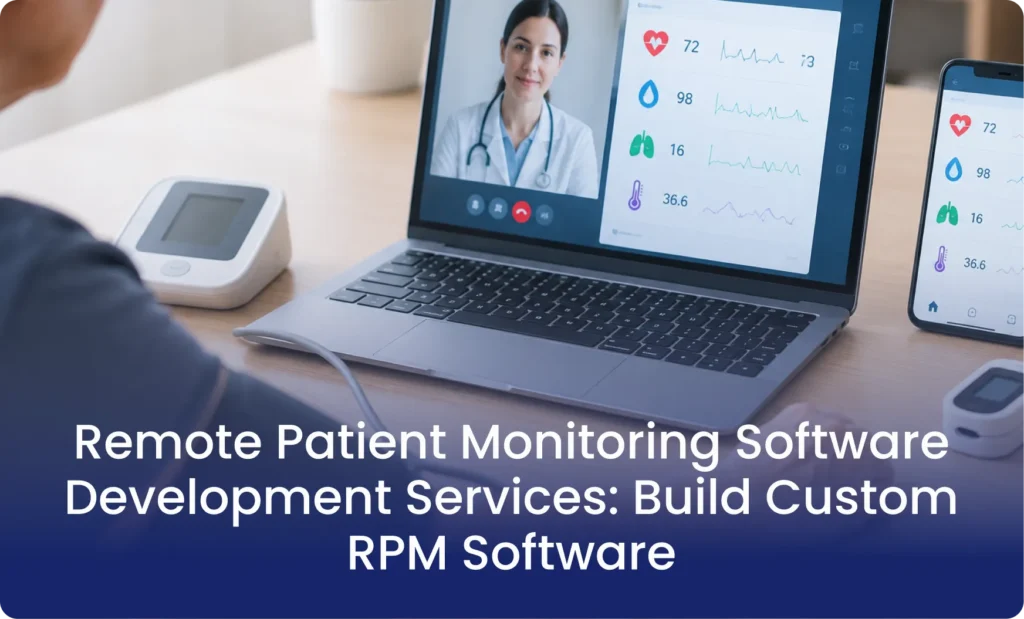
Remote patient monitoring software development services help healthcare organizations build secure platforms for monitoring patients outside traditional clinical settings. These platforms collect health data through connected medical devices and share readings with healthcare providers. Doctors can review patient information, identify concerning changes, and manage care remotely.
Healthcare providers, hospitals, medical practices, and digital health companies increasingly need flexible monitoring solutions. Ready-made platforms may not support every clinical workflow or integration requirement. Custom remote patient monitoring software offers greater flexibility, allowing organizations to build solutions around their patients, devices, and operational needs.
MediRemote helps healthcare organizations understand remote monitoring technology and its role in modern care delivery.
What Are Remote Patient Monitoring Software Development Services?
Remote patient monitoring software development services involve designing, building, integrating, and maintaining digital platforms for remote healthcare monitoring.
These services connect patients, medical devices, healthcare professionals, and administrative teams through one digital system.
A typical RPM platform includes:
- Patient mobile applications for submitting and viewing health readings.
- Physician dashboards for reviewing patient measurements.
- Admin panels for managing users and monitoring programs.
- Medical device integrations for automatic data collection.
- Alert systems for identifying unusual readings.
- Reporting tools for reviewing patient monitoring activity.
- EHR integrations for exchanging patient information.
For example, a patient with hypertension can use a connected blood pressure monitor at home. The device sends readings to the RPM platform. Their healthcare provider can review these measurements and decide whether additional attention is necessary.
This approach supports ongoing care without requiring patients to visit clinics for every routine measurement.
Why Healthcare Organizations Need Custom Remote Patient Monitoring Software
Every healthcare organization has different clinical requirements. A small medical practice may need basic patient monitoring, while a hospital network may require multiple dashboards and complex integrations.
Custom remote patient monitoring software helps organizations address these differences.
1. Flexible Clinical Workflows
Healthcare teams can organize patient enrollment, monitoring schedules, notifications, and reporting around their existing processes.
2. Better Device Compatibility
Custom platforms can connect with selected medical devices through Bluetooth, Wi-Fi, cellular networks, and manufacturer APIs.
3. Improved Data Management
Providers can access patient readings, historical trends, and monitoring information through centralized dashboards.
4. Easier System Integration
Custom solutions can connect with existing EHR and EMR systems. This reduces disconnected records and unnecessary manual work.
5. Long-Term Scalability
Organizations can expand their platforms as patient numbers, monitoring programs, and operational requirements grow.
Essential Features of Remote Patient Monitoring Software
A successful RPM platform needs more than a patient application. It should support the complete monitoring process.
1. Patient Mobile Application
The patient application provides a simple way to participate in remote monitoring.
Important features include:
- Patient registration and secure login.
- Device connection instructions.
- Health reading history.
- Medication and measurement reminders.
- Notifications and care team communication.
- Easy-to-understand health information.
A simple interface is especially important for patients who are unfamiliar with digital healthcare tools.
2. Physician Dashboard
Physician dashboards help clinical teams review patient information without checking multiple systems.
Useful capabilities include patient lists, vital sign trends, reading history, alerts, and clinical notes.
Providers can review blood pressure, glucose, oxygen saturation, and weight measurements. They can also identify readings that require further clinical attention.
3. Automated Alerts and Notifications
RPM software should support configurable alerts based on clinician-defined thresholds.
For example, a patient with hypertension may generate an alert when blood pressure readings exceed their assigned limits.
The system can notify authorized clinical staff for review. Alert prioritization can also help teams manage large patient populations.
4. Reporting and Analytics
Reporting tools help healthcare organizations understand monitoring activity.
Useful reports include patient enrollment, device usage, collected readings, monitoring days, and staff activity.
These reports can also support operational reviews and billing documentation. However, software reports do not independently establish Medicare coverage or guarantee reimbursement.
Medical Device and EHR Integration
Device compatibility is one of the most important parts of RPM software development.
Common connected devices include:
- Blood pressure monitors.
- Blood glucose meters and continuous glucose monitors.
- Pulse oximeters.
- Digital weight scales.
- Connected thermometers.
Developers may use Bluetooth Low Energy (BLE), Wi-Fi, cellular connections, and device manufacturer APIs to collect readings.
EHR integration is equally important. Healthcare organizations may require connections with Epic, Oracle Health, athenahealth, or other systems.
Standards such as HL7 and FHIR help exchange healthcare information between compatible platforms.
A properly planned integration allows patient information to move between systems more efficiently. It also reduces duplicate data entry and supports better clinical workflows.
Explore MediRemote’s remote patient monitoring software solutions to understand how digital monitoring platforms support healthcare organizations.
AI and Automation in Custom RPM Software
Artificial intelligence is creating new opportunities for remote monitoring platforms. Healthcare organizations can use AI-assisted features to organize patient information and support clinical workflows.
Important applications include:
Predictive analytics: Software can analyze historical measurements and identify patterns that may indicate changing patient conditions.
Intelligent alert prioritization: AI-assisted systems can help clinical teams organize alerts according to defined risk indicators.
Automated summaries: Platforms can prepare summaries of patient readings for clinical review.
Trend analysis: Automated tools can identify changes in blood pressure, glucose, weight, and other measurements.
Patient engagement: Automated reminders can encourage patients to submit readings and follow monitoring schedules.
AI features must undergo appropriate testing and clinical oversight. Software intended to provide medical recommendations may also require FDA regulatory assessment depending on its functions and intended use.
HIPAA Compliance and Data Security
Healthcare organizations must follow applicable HIPAA Security Rule requirements to protect electronic patient information.
RPM platforms handle sensitive patient information. Security must therefore be included throughout the development process.
Important safeguards include:
- Encryption for stored and transmitted information.
- Multi-factor authentication.
- Role-based access controls.
- Secure cloud infrastructure.
- Audit logs and access monitoring.
- Regular security testing.
- Backup and recovery procedures.
- Appropriate Business Associate Agreements.
The HIPAA Security Rule requires covered entities and business associates to implement administrative, physical, and technical safeguards for electronic protected health information.
HHS also published a proposed Security Rule update in December 2024. As of October 2026, the existing Security Rule remains in effect while that proposed rulemaking is pending.
Healthcare organizations should also consider FDA requirements when developing software with medical device functions or clinical decision support capabilities. The FDA issued updated Clinical Decision Support Software guidance on January 29, 2026.
2026 RPM Reimbursement and Software Requirements
Medicare reimbursement rules are another important consideration when developing RPM software for US healthcare organizations.
For 2026, the RPM code set includes two new CPT codes:
- 99445: Covers device supply and data transmission for 2–15 days within a 30-day period.
- 99470: Covers the first 10 minutes of RPM treatment management services.
These additions provide options for certain shorter monitoring periods and management activities.
Software developers should consider features that support:
- Monitoring-day calculations.
- Patient consent records.
- Device reading history.
- Clinical staff activity tracking.
- Treatment management documentation.
- Monthly reporting.
CMS also published a proposed 2027 Physician Fee Schedule containing potential changes to RPM and RTM requirements, including proposals concerning clinical staff employed by practices.
These are proposed changes, not finalized 2027 requirements. Healthcare organizations should review applicable CMS policies before configuring billing workflows.
How to Develop Custom Remote Patient Monitoring Software
Building an RPM platform requires careful planning and collaboration between healthcare professionals and software developers.
Step 1: Identify Your Requirements
Define the conditions you want to monitor, your target patients, and the healthcare workflows your platform must support.
Step 2: Plan the Software Architecture
Choose the required applications, dashboards, cloud infrastructure, security controls, and integration methods.
Step 3: Design the User Experience
Create simple interfaces for patients, doctors, and administrators. Make common tasks easy to complete.
Step 4: Integrate Medical Devices
Connect compatible devices and test how readings move into the software.
Step 5: Develop Core Features
Build patient management, monitoring dashboards, notifications, reporting, and communication features.
Step 6: Test Security and Performance
Test data accuracy, device connectivity, user permissions, security controls, and platform performance.
Step 7: Deploy and Maintain the Platform
Launch the software, train users, monitor performance, and provide ongoing updates and technical support.
How Much Does Custom Remote Patient Monitoring Software Development Cost?
The cost depends on the platform’s complexity, required features, integrations, and development scope.
A basic MVP may cost significantly less than a complete enterprise platform. Custom patient applications, multiple device integrations, AI capabilities, and complex EHR connections can increase the overall investment.
Important cost factors include:
- Number of applications and dashboards.
- Medical device compatibility.
- EHR and EMR integrations.
- Security and compliance requirements.
- AI and analytics features.
- Cloud hosting and infrastructure.
- Ongoing maintenance and technical support.
Published development estimates vary considerably. Therefore, organizations should request a detailed project assessment rather than relying on one general price.
Custom RPM Software vs. Ready-Made Solutions
Ready-made RPM platforms can help organizations launch monitoring programs quickly. However, their features and integrations may not match every business requirement.
Custom solutions offer greater control over functionality, workflows, integrations, and future development.
Organizations should compare initial investment, implementation time, ownership arrangements, maintenance responsibilities, and scalability before choosing an approach.
Custom development is particularly useful when existing solutions cannot support specific clinical or operational requirements.
Frequently Asked Questions
1. What are remote patient monitoring software development services?
These services include designing, developing, integrating, and maintaining software that collects patient health data through connected medical devices.
2. How much does custom remote patient monitoring software cost?
Costs depend on features, integrations, security requirements, and project complexity. A detailed development assessment provides a more accurate estimate.
3. Which devices can connect to RPM software?
Common devices include blood pressure monitors, glucose meters, pulse oximeters, weight scales, and connected thermometers.
4. Can RPM software integrate with Epic and athenahealth?
Yes. Developers can use supported APIs and healthcare interoperability standards to connect RPM platforms with compatible EHR systems.
5. Does RPM software need HIPAA compliance?
Software handling electronic protected health information must support applicable HIPAA requirements. Covered entities and business associates have specific security responsibilities.
6. Can AI be integrated into custom RPM software?
Yes. AI can support trend analysis, alert prioritization, automated summaries, and predictive analytics, subject to appropriate validation and oversight.
Conclusion
Remote patient monitoring is becoming an important part of connected healthcare. Healthcare organizations need reliable platforms that support device connectivity, patient engagement, clinical workflows, and secure data management.
Choosing the right remote patient monitoring software development services can help organizations build solutions around their specific requirements. From patient applications and physician dashboards to AI-assisted analytics and EHR integrations, every component should support practical healthcare needs.
MediRemote understands the importance of effective remote monitoring solutions for modern healthcare. Our focus is helping healthcare organizations explore technology that supports better monitoring workflows, stronger patient engagement, and more connected care delivery.